OCPP 1.6J vs OCPP 2.0.1: Key Differences in EV Charging Protocols
As the global electric vehicle infrastructure matures, open communication protocols ensure seamless interoperability between EV charging stations and Central Management Systems. While OCPP 1.6J has long served as the industry workhorse, OCPP 2.0.1 introduces critical upgrades designed for modern grid integration, advanced security, and seamless user experiences.
Core Comparison Breakdown
Understanding the differences between OCPP 1.6J and OCPP 2.0.1 is essential for charge point operators, EV infrastructure developers, and businesses investing in charging networks. Here is a detailed breakdown of the key distinctions.
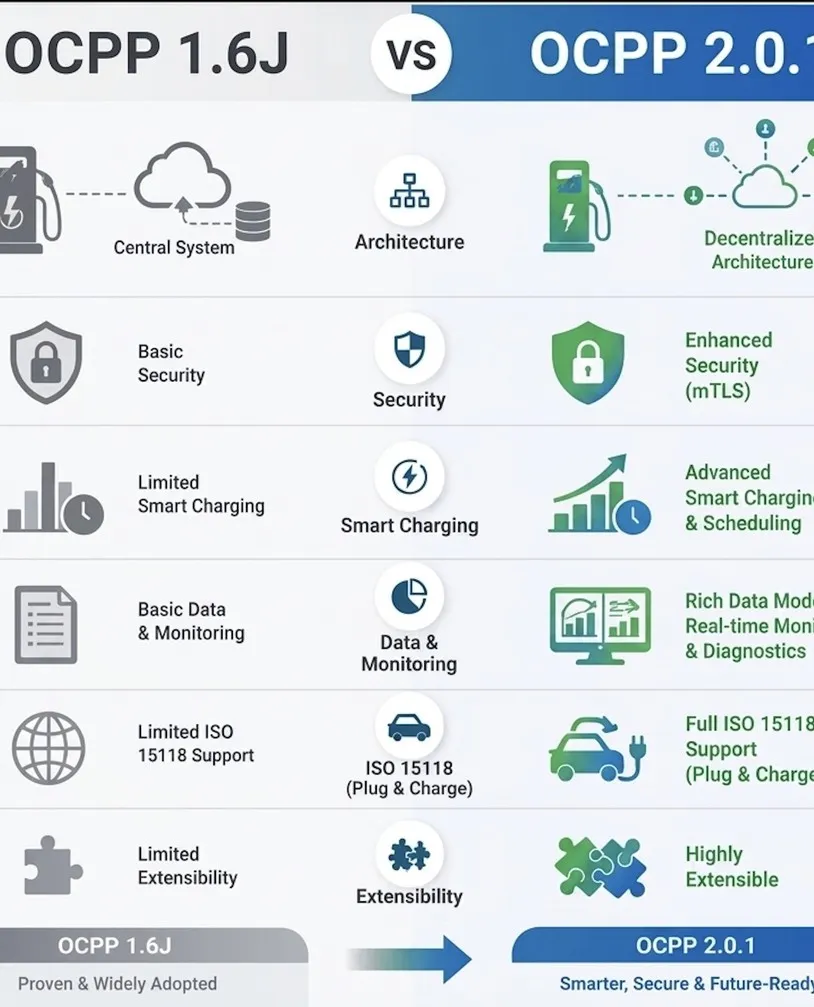
1. Architecture: Centralized vs. Decentralized
OCPP 1.6J
Relies on a traditional, centralized system architecture where all charging stations communicate with a single central management system.
OCPP 2.0.1
Adopts a decentralized architecture that improves modularity, scalability, and system resilience, allowing for more flexible network designs.
2. Enhanced Security Features
OCPP 1.6J
Provides basic security mechanisms suitable for legacy networks, but lacks modern encryption standards.
OCPP 2.0.1
Integrates robust security protocols out of the box, including mutual TLS (mTLS) for encrypted and authenticated network communication, significantly improving cybersecurity posture.
3. Smart Charging & Scheduling Capability
OCPP 1.6J
Offers limited smart charging capabilities suited for standard load control and basic power management.
OCPP 2.0.1
Enables advanced smart charging, intricate load balancing, dynamic tariff management, and sophisticated power scheduling for optimized energy distribution.
4. Real-time Data & Diagnostics
OCPP 1.6J
Supports basic telemetry and event monitoring with limited diagnostic capabilities.
OCPP 2.0.1
Delivers a rich data model featuring comprehensive real-time monitoring, granular error handling, and predictive diagnostics for proactive maintenance.
5. Plug & Charge (ISO 15118 Support)
OCPP 1.6J
Provides limited capabilities for ISO 15118 integration, requiring additional workarounds for plug-and-charge functionality.
OCPP 2.0.1
Delivers full native support for ISO 15118, unlocking seamless "Plug & Charge" experiences without requiring manual app or RFID authentication.
6. Extensibility & Future-Proofing
OCPP 1.6J
Highly proven and widely adopted, but limited in custom feature extension and adaptation to emerging standards.
OCPP 2.0.1
Built to be highly extensible, smarter, more secure, and inherently future-ready for evolving market demands and next-generation EV technologies.
Why Upgrade to OCPP 2.0.1?
While OCPP 1.6J remains reliable and widely deployed, upgrading to OCPP 2.0.1 provides charge point operators with lower operational overhead, enhanced cybersecurity protection through mTLS, and full alignment with upcoming automotive standards like ISO 15118. For new deployments, OCPP 2.0.1 is the clear choice for long-term scalability and security.
Altarbyte's Commitment to Open Standards
Altarbyte supports both OCPP 1.6J and OCPP 2.0.1 across our charging product lineup. Our 240kW DC fast chargers, AC chargers, and smart charging management systems are designed for seamless protocol integration, ensuring compatibility with existing infrastructure while enabling future upgrades. Whether you are deploying a new network or modernizing an existing one, Altarbyte provides the expertise and technology to keep you connected.
Share This Article
Related Articles
The Future of Fast Charging: What to Expect in 2026
Explore the latest advancements in DC fast charging technology and how they are revolutionizing EV infrastructure.
EV Charging Station Electrical Infrastructure
Complete guide to electrical systems for EV charging stations in India.
India Hits Milestone EV Growth: June 2026
India records highest-ever EV sales in June 2026 with 3.06 lakh units sold, up 63% YoY.
Upgrade Your Charging Infrastructure
Explore Altarbyte's range of OCPP-compliant EV charging solutions. Get expert guidance on protocol selection and network architecture for your deployment.
Compliance & Certification
Altarbyte products and installations are fully compliant with Indian regulatory requirements and international standards.