OCPP vs OCPI: Understanding the Core Differences in EV Protocols
In the rapidly growing EV ecosystem, seamless communication between charging hardware, management platforms, and roaming networks is critical. While both OCPP and OCPI are essential standards in green mobility infrastructure, they serve completely different roles in EV software architecture.
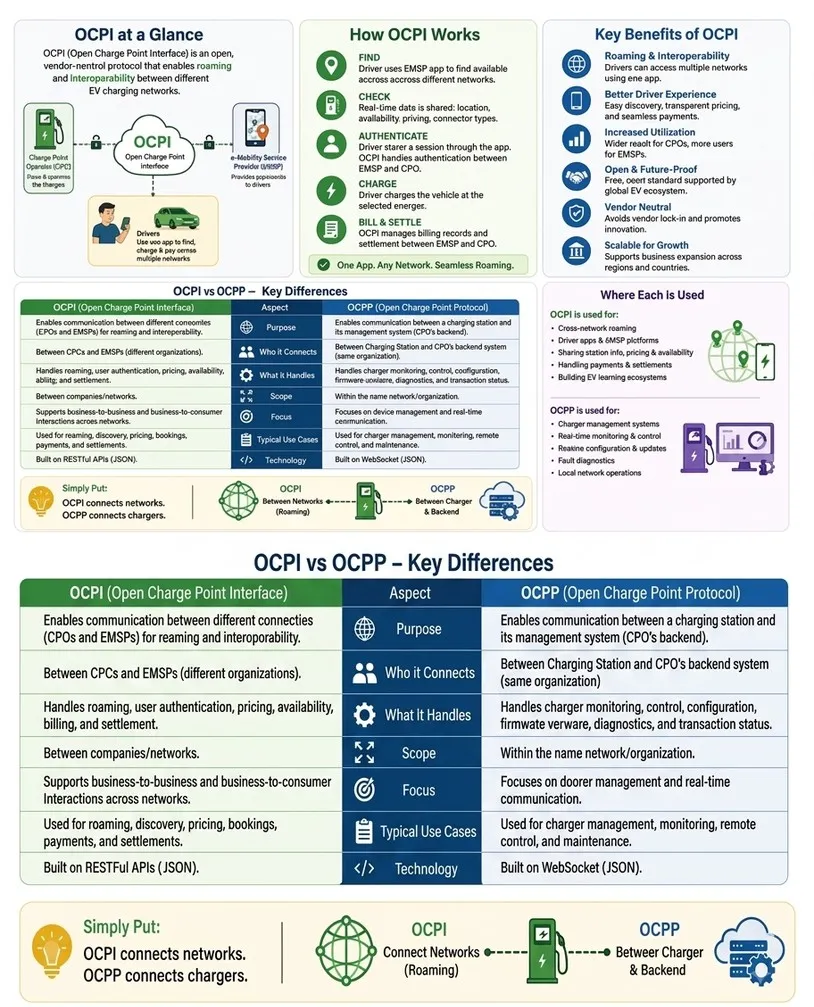
OCPP vs OCPI protocol comparison for EV charging infrastructure.
Demystifying the Difference: Device Management vs. Roaming
To understand the difference, consider this analogy: OCPP acts like the operating connection between a printer and a computer—it controls hardware functions directly. OCPI acts like mobile network roaming—it allows a user subscribed to Network A to seamlessly plug in and charge on Network B using their existing app and billing account.
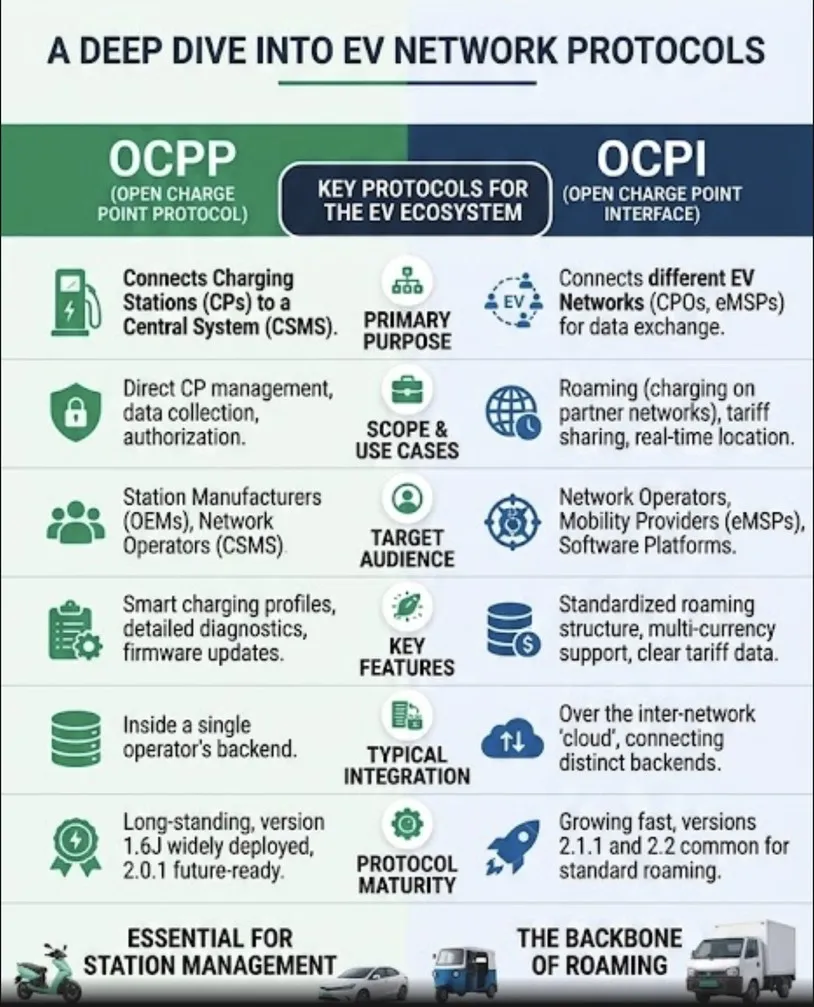
Detailed comparison of OCPP and OCPI protocols for EV charging.
OCPP vs OCPI: Detailed Comparison
| Feature / Aspect | OCPP (Open Charge Point Protocol) | OCPI (Open Charge Point Interface) |
|---|---|---|
| Primary Focus | Charger-to-Backend Management | Backend-to-Backend Roaming |
| Connection Topology | EV Charger (EVSE) → Central System (CSMS) | CPO (Charge Point Operator) → eMSP (E-Mobility Service Provider) |
| Key Function | Hardware configuration, remote start/stop, telemetry, diagnostic logs | Cross-network roaming, tariff sync, session data exchange, location discovery |
| Target Users | Charge Point Operators (CPOs), Hardware Manufacturers | Network Operators, EV Drivers, Fleet Management Apps |
| Primary Benefit | Hardware vendor independence & remote charger telemetry | Seamless multi-network access for drivers without needing multiple apps |
1. OCPP (Open Charge Point Protocol)
Key Benefits
- • Hardware Agnostic: Allows operators to connect chargers from different manufacturers to a single central backend.
- • Real-time Diagnostics: Enables remote rebooting, firmware updates, and status monitoring to minimize downtime.
- • Smart Charging: Optimizes power distribution across multiple chargers on the grid.
Primary Use Cases
- • Setting up a fleet charging depot or commercial parking facility
- • Managing physical charging station hardware and monitoring energy consumption
2. OCPI (Open Charge Point Interface)
Key Benefits
- • Seamless Roaming: Enables EV drivers to locate, access, and pay at third-party stations using a single mobile application.
- • Automated Clearing & Billing: Streamlines automated financial settlement between different network providers.
- • Real-time Station Availability: Shares live charger availability across maps and third-party apps like Google Maps and Apple Maps.
Primary Use Cases
- • Enabling roaming partnerships between different EV charging networks
- • Aggregating charging location data and real-time status updates across regions
Summary
Use OCPP to connect and control your charging hardware to your central software. Use OCPI to connect your central software with other EV service provider networks so drivers can roam effortlessly. Together, OCPP and OCPI form the digital backbone of modern, interconnected, and scalable EV infrastructure.
Altarbyte's Protocol Expertise
Altarbyte supports both OCPP 1.6J and OCPP 2.0.1 across our charging product lineup, with OCPI-ready backend integration for roaming and interoperability. Our 240kW DC fast chargers, AC chargers, and smart charging management systems are designed for seamless protocol integration, ensuring compatibility with existing infrastructure while enabling future upgrades. Whether you are deploying a new network or modernizing an existing one, Altarbyte provides the expertise and technology to keep you connected.
Share This Article
Related Articles
OCPP 1.6J vs OCPP 2.0.1: Key Differences
Compare OCPP 1.6J vs OCPP 2.0.1 protocols for EV charging. Learn about architecture, security, smart charging, and ISO 15118 support.
The Future of Fast Charging: What to Expect in 2026
Explore the latest advancements in DC fast charging technology and how they are revolutionizing EV infrastructure across India.
India Hits Milestone EV Growth: June 2026
India records highest-ever EV sales in June 2026 with 3.06 lakh units sold, up 63% YoY.
Upgrade Your Charging Infrastructure
Explore Altarbyte's range of OCPP and OCPI-compatible EV charging solutions. Get expert guidance on protocol selection and network architecture for your deployment.
Compliance & Certification
Altarbyte products and installations are fully compliant with Indian regulatory requirements and international standards.